

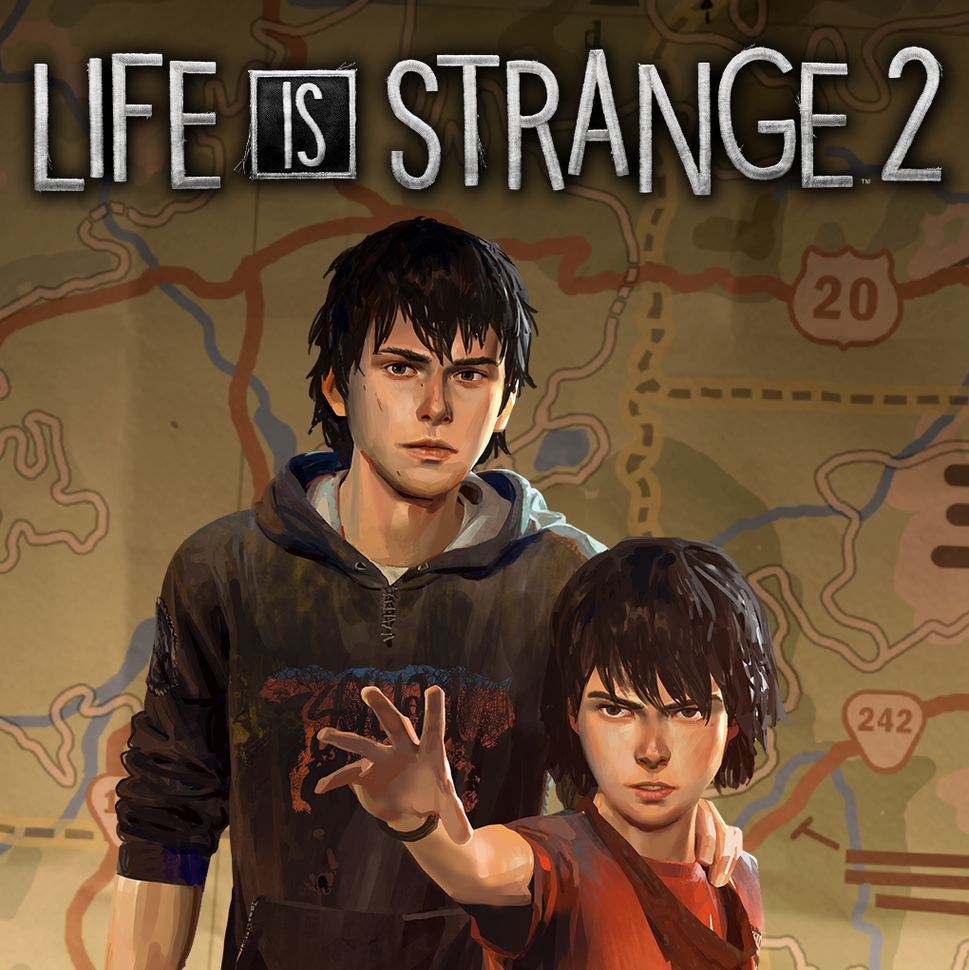
Life Is Strange 2: Complete Season 1.0.2 Mac
Remote manipulation—the ability to shift objects with a thought—is a power Daniel Diaz discovers in a moment of trauma, and it instantly changes the course of his and older brother Sean's lives. Life Is Strange 2: Complete Season unfolds across five episodes that follow the pair as they flee Seattle and head south, navigating a world that often treats them with suspicion.
The player spends most of the game controlling Sean, making choices that define what kind of role model he becomes. These decisions rarely fit a simple good-or-bad framework. A scene might ask whether to steal camping gear, borrow it, or ask permission; another might force a choice between lying to a stranger, telling the truth, or swallowing pride and asking for help. The brothers' bond is measured through Daniel's trust, and that meter moves according to actions the player takes over hours of play.
Much of the experience alternates between watching cutscenes and selecting dialogue responses, with some sections opening into point-and-click exploration. The complete season, developed for Mac by DONTNOD Entertainment and Feral Interactive, includes all five episodes and runs natively on both Apple Silicon and Intel Macs.
Relationships over puzzles, with a morality system that punishes consistency
- Players who enjoy character-driven stories where relationships carry more weight than puzzles.
- Anyone interested in moral systems that punish consistency—doing the “right” thing once can backfire later.
- Fans of slow-burn road trips that take time establishing mood and place.
A mostly on-rails road trip built on dialogue scenes and slow-burn mood
- The game is largely on rails; players looking for open-world freedom or action mechanics will find little here.
- Dialogue choice and cutscene watching form the bulk of interaction, which can feel passive across long sessions.
- Emotional payoffs depend heavily on the player's patience with two young protagonists making frustrating decisions.
A full episode workflow, from Seattle to the road
Episode 1 opens in the Diaz family home, and the first 20 minutes set the tone for how the rest of the season plays. A player settling in can treat this section as a calibration run—interact with every object in Sean’s room, read texts on his phone, and talk to Daniel before anything goes wrong. The game remembers these small moments, and Daniel’s later reactions often reference whether Sean was attentive or dismissive at the start.
Once the brothers hit the road, the player’s routine shifts. Each new location—a gas station, a forest camp, a motel—follows a loose loop: sweep the area for items, decide what to take and how to take it, then steer a conversation with Daniel or a stranger. A practical approach is to let Daniel speak first when the option appears. His dialogue often reveals what he needs emotionally, and responding to that need—rather than rushing to solve a problem—tends to keep the trust meter steady. When items like food or money are scarce, the player can pause at the inventory screen and weigh whether taking a risk now will leave fewer options later. The game does not signal long-term consequences, so keeping a mental note of each lie or theft helps when episodes 3 and 4 call back to earlier choices.
Daniel’s sudden defiance at the camp, and why it is not a bug
A frequent frustration surfaces around episode 3, when the brothers reach a camp of itinerant workers. Several players report that Daniel’s behaviour shifts abruptly—becoming defiant or reckless—regardless of earlier choices. This is not a bug but a delayed consequence of trust thresholds from episodes 1 and 2. If Daniel feels Sean has not been honest or has treated him like a child, the friction surfaces here. The fix is to avoid doubling down on authority. Choose dialogue that admits mistakes rather than lecturing; it stabilises the relationship for the final two episodes.
Another pain point: the point-and-click sections sometimes stall when an interaction prompt fails to appear. In the Mac version tested, moving Sean a few steps away and returning to the object usually resets the prompt. On one occasion in episode 4, a cutscene hung on a black screen after a dialogue choice. Quitting and relaunching restored progress from the last autosave, which the game places shortly before each major decision point. Players who skip the optional sketchbook moments in Sean’s inventory also miss context that explains later dream sequences—pausing to examine new drawings between scenes fills in gaps the dialogue leaves open.
- macOS 10.15 or later
- 4 GB RAM
- 42 GB available disk space
- Version
- 1.0.2 fix
- Download
- 41 GB
- Developer
- Dontnod Entertainment, Feral Interactive
- Languages
- Russian, English, German, Spanish, Italian, Chinese (Simplified), Portuguese, French
- Activation
- Not required
- Architecture
- Apple Silicon, Intel 64-bit
- Tested on
- macOS Sequoia, MacBook Air (M1. 2020)
- Release date
- 26.09.2018
- Voice
- English, Japanese
Questions readers asked
Yes, the Mac version includes native support for both Apple Silicon and Intel Macs.
Sign in or open a desk account to write a letter.
No letters on this brief yet. They are read before they run.









 Top
Top