

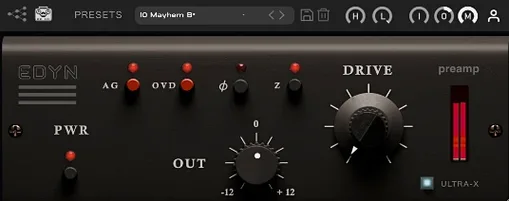
Tone Empire EDYN 1.0.2 Mac
Mixing engineers chasing a recognizable vintage tone have a new option from Tone Empire. The EDYN Pre plugin models an analog preamplifier inspired by American consoles from the 1960s and 1970s, and it has already landed a stability update.
Where the plugin lands in a session shapes what it does. Here is a common workflow.
- Individual tracks. Place EDYN first in the insert chain on drums and vocals. Engage the OVD overdrive mode lightly to push a signal into gentle saturation before it hits any compressors.
- Group buses. Insert the plugin on a drum bus or backing vocal bus. Automatic gain compensation keeps perceived loudness steady while you drive the input for more color.
- Parallel processing. Send tracks to an aux with EDYN set to heavy overdrive. Flip the phase inversion switch to check for any cancellation issues when blending the return with the dry signal.
- Master output. Apply the preamp with drive set low for subtle glue. The 1.0.1 update addressed offline rendering problems on the master, so bouncing a mix with the plugin active is now reliable.
The NM2 ENGINE technology underpins the emulation, and the plugin runs natively on Apple Silicon and Intel 64-bit systems. Version 1.0.2 cleared up automation hiccups in Pro Tools and crashes when loading multiple instances in Logic Pro.
Flip the impedance switch before touching Drive
Open the plugin and the Drive knob gets the attention, but three other controls shape the sound before saturation even begins. The input impedance switch sits at the top of the interface and is easy to overlook. Toggling between 50 ohms and 200 ohms changes how the preamp loads the incoming signal. The 50-ohm setting tightens the low end and pulls the midrange forward — useful on a boomy floor tom or a vocal that needs to cut through a dense arrangement. The 200-ohm position rounds off transients slightly and opens up the top end, which can rescue a harsh cymbal track without reaching for a de-esser.
The high-pass filter deserves an early adjustment on almost any source. Set it between 80 Hz and 120 Hz on vocals and guitars to clear out low-end rumble before the Drive stage adds harmonics. The low-pass filter works the other direction, taming brittle highs on DI bass or softening a synth pad. Both filters sit before the saturation circuit, so they affect what the Drive module reacts to — a different result than filtering after the fact.
Automatic gain compensation is on by default, and leaving it engaged prevents loudness tricks from skewing decisions. Bypass it briefly when dialing in heavy OVD overdrive to hear exactly how much the signal is being pushed, then re-engage it to judge the tone at a matched level.
Runs cooler on Intel and M-series after the 1.0.2 update
Does it work on an older Mac? The system requirement is macOS 10.14 or later, so any machine running Mojave or newer qualifies. The plugin includes both Intel and Apple Silicon binaries, and the 1.0.2 update specifically reduced CPU load on Apple Silicon systems. Users on older Intel Macs can run it, though session size will dictate how many instances are practical.
Will it pass Logic Pro validation? The 1.0.2 release addressed AU validation failures that some users hit on macOS Sequoia. The fix applies to the current build, so a clean scan in Logic's Plugin Manager should succeed on first launch.
Is offline bouncing stable now? Version 1.0.1 targeted offline rendering bugs on the master output, and 1.0.2 continued that work with further fixes. Mixes with EDYN on the master bus should bounce without glitches or blank audio segments.
Does it hold up under multiple instances? The crash that occurred when loading several instances in Logic Pro was patched in 1.0.2. Sessions with the plugin spread across individual tracks, buses, and aux returns are now stable.
What plugin formats are included? VST3, AU, and AAX — the three formats cover most DAWs on macOS without converters or wrappers.
Keeps kick and snare transients alive while thickening the bus
Mixing engineers who work with live drum recordings benefit immediately. The fast transient response of the modeled discrete transistor circuit preserves the attack of a kick drum or snare while the Drive stage adds density around it. A drum bus with the impedance set to 50 ohms and the high-pass filter engaged around 60 Hz delivers a punchy, controlled foundation that takes compression well later in the chain.
Vocal producers looking for presence without harshness find a strong match here. The bright midrange character of the Electrodyne 1204 emulation pushes a vocal forward in a mix, and the parallel Mix control means that presence can be blended in rather than printed destructively. Setting the Mix knob to 40–50% wet on a lead vocal retains natural dynamics while layering in the preamp's tonal imprint.
Users with aging Intel Macs who want console-style saturation without taxing their systems should note the CPU optimizations in 1.0.2. The plugin is lean enough to run across a full tracking session, and the scalable interface means high-resolution displays on newer Macs are supported without blurry text or cramped controls.
Anyone who learned mixing on hardware and wants a familiar signal-flow logic will appreciate the layout. Input gain, filters, drive, and output level follow the order of a physical console channel strip. There is no menu diving or modulation matrix — just a row of controls that behave the way an analog desk would. The phase inversion switch is a small touch, but it saves a trip to a separate utility plugin when checking parallel chains.
Bedroom producers building a first mix template get a flexible tone shaper that covers clean warmth at low Drive settings and aggressive saturation when OVD mode is engaged. Because the filters hit before the saturation, a single instance can clean up low end and add character simultaneously — two jobs that might otherwise need separate EQs and saturators.
Version 1.0.2 landed with a series of fixes aimed at DAW stability. Parameter automation now behaves correctly in Pro Tools, and crashes triggered by multiple instances in Logic Pro have been resolved. The update also addresses AU validation issues in Logic Pro on macOS Sequoia and improves Apple Silicon performance with reduced CPU load. Earlier patches fixed offline rendering on the master output and added a scalable interface for high-resolution displays.
- macOS 10.14 or later
- Apple Silicon or Intel 64-bit processor
- Formats: VST3, AU, AAX
- Version
- 1.0.2
- Download
- 198 MB
- Developer
- Tone Empire
- Languages
- English
- Activation
- K'ed by MORiA
- Compatibility
- macOS 10.14 or later
- Architecture
- Apple Silicon, Intel 64-bit
Questions readers asked
Yes. It features an OVD overdrive mode that can be engaged to add harmonic saturation beyond standard preamp coloration.
The 1.0.2 update improved support for high-resolution displays with a scalable interface, so the plugin adapts to modern monitor setups.
Sign in or open a desk account to write a letter.
No letters on this brief yet. They are read before they run.






 Top
Top