

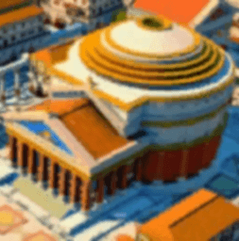
Nova Roma 0.7.2703 Mac
Anyone who has spent hours laying out residential blocks in a Caesar or Pharaoh title will recognize the bones of Nova Roma immediately. The difference is what the simulation tracks under the hood. Citizen needs still drive the economy, but the land itself pushes back. Water flows downhill whether you planned for it or not. Rain swells rivers. Crops fail in drought. A dam placed without surveying the catchment above it is just expensive masonry.
First steps in a new province
- Survey the terrain. The game models landscape, hydrodynamics, and weather, so the map dictates where farms and reservoirs can work.
- Lay out housing and basic supply chains. Citizens need food, water, and goods before they will upgrade their dwellings.
- Build a temple early. Neglecting the gods carries consequences that no amount of grain can fix.
- Plan water infrastructure. Aqueducts and dams move fresh water across elevation changes; irrigation keeps farmland productive through dry seasons.
- Expand carefully. Every new district competes for the same water, labor, and divine patience that the old ones rely on.
What the gods want
Nova Roma treats religion as a resource problem with a mood meter. Temples please specific deities, and an offended god can undo months of careful planning with a single bad harvest or a structural collapse. The balance sits alongside the more familiar logistics of warehousing, trade, and population growth, so a thriving city is never just an engineering puzzle.
A magistrate’s afternoon
Picture a player who cut their teeth on Anno and Pharaoh and now spends Saturday mornings with coffee and a slow-burning city. For them, Nova Roma hits a sweet spot: the supply-chain clarity of a classic builder, but with hydrology that punishes lazy placement. One recent session went sideways when a town that had sailed through three winters suddenly faced bread riots. The player traced the shortage to a single aqueduct branch that fed the mill district—a branch that ran dry because a new vineyard upstream was siphoning the reservoir faster than the spring could refill it. Fixing it meant demolishing two insulae, rerouting the channel through lower ground, and passing a grain-ration law to buy time. That afternoon had no combat, no disaster script, just a quiet failure of planning that felt entirely earned.
Drops into any Mac account without launchers
Because the game ships DRM‑free and runs natively on both Apple Silicon and Intel Macs, it slots into a Mac workflow without launchers or background services. Players who keep separate user accounts for work and play can drop the app into a shared /Applications folder and launch it from either side. The build tested smooth on macOS Tahoe, and on a Mac mini M4 it leaves enough headroom to keep a browser, a note‑taking app, and a wiki about Roman aqueducts open on a second display. The game stores saves locally, so they are easy to back up with Time Machine or to move between machines by copying the profile folder. Windowed mode plays nicely with Stage Manager, letting the city tick over in the background while messages or a spreadsheet sit beside it.
Flatten a phantom slope to fix dry pipes
Water not reaching a district. The landscape model reads elevation changes strictly, so a pipe that looks flat on screen may be climbing a gentle slope. Demolish the conduit and rebuild it one tile at a time while watching the flow indicator. If the indicator drops to zero midway, the route needs a lower path or a small reservoir to bridge the rise.
Sudden collapse of housing blocks. This is almost always a deity problem. Check the temple overview: an ignored god can trigger structural failures that look like engineering faults. Building a second shrine to the offended deity usually halts the decay within a season.
Gladiator schools cost more than they earn. A ludus drains food and wages unless you have a steady supply of slaves from military campaigns or trade. Until the city reaches that stage, focus on craftsmen and actors—they turn a profit sooner and keep the populace happier during sluggish growth phases.
Dams that hold no water. A dam needs a catchment basin upstream that actually collects rainfall. Before placing one, watch the terrain during a rain cycle. Gullies and natural bowls fill visibly; a dam built across bare rock with no runoff remains a dry wall. Some players mark promising sites with a row of cheap shrines and wait for a storm to confirm the flow.
- Apple Silicon or Intel 64-bit Mac
- Version
- 0.7.2703
- Download
- 374 MB
- Developer
- Lion Shield
- Languages
- Russian, English, German, Hungarian, Spanish, Italian, Chinese (Traditional), Chinese (Simplified), Korean, Polish, Portuguese, Turkish, Ukrainian, French, Czech, Japanese
- Activation
- DRM-free
- Architecture
- Apple Silicon, Intel 64-bit
- Tested on
- macOS Tahoe, Mac mini 2024 M4
- Release date
- 26.03.2026
- Voice
- Music only
Questions readers asked
The interface is available in sixteen languages including English, Russian, German, Spanish, French, Japanese, Korean, and both Traditional and Simplified Chinese.
Sign in or open a desk account to write a letter.
No letters on this brief yet. They are read before they run.








 Top
Top