

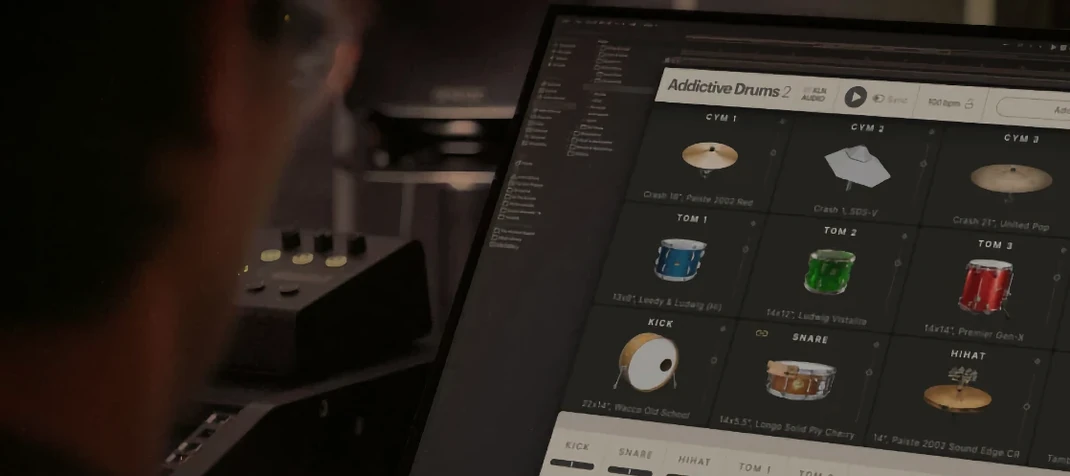
Addictive Drums 2 2.9.1 Mac
Version 2.9.1 is the current release, and while XLN Audio did not publish a change log for this revision, the software continues to function as a 64‑bit plugin and standalone application on macOS 10.13 and later. It sits comfortably next to a Mac user's existing DAW, responding to MIDI from a keyboard, pad controller, or a piano‑roll editor without demanding a separate hardware module.
The Complete Collection bundles Addictive Drums 2 with every ADpak, MIDIpak, and Kitpiece Pak the developer offers. ADpaks are expansion products that add recorded kits — from vintage dead rooms to tight modern booths — so the core engine grows into a broader palette without leaving the single‑window interface.
Inside a session, the software behaves like a dedicated drum room: individual kit pieces route to separate mixer channels, letting an engineer apply EQ and compression inside the plugin before the signal hits the DAW faders. For someone already balancing synth plugins and amp sims on a Mac, that means fewer auxiliary tracks and a drum sound that arrives mix‑ready.
The interface is available only in English, but the layout relies on familiar console‑style knobs and a clickable kit graphic, so navigation leans on muscle memory rather than language menus.
Click the drum kit itself to reveal hidden menus
Every virtual drum instrument ships with a handful of small touches that take weeks to notice unless someone points them out. Addictive Drums 2 is no exception. The kit graphic itself is clickable — not just for selecting pieces, but for muting them with a quick right-click. Hold the Option key while dragging a fader in the mixer and the movement slows to a finer resolution, handy when a snare bottom mic needs half a decibel of adjustment, not two.
The built-in metronome sits in the transport bar and syncs to the DAW tempo automatically, but it also sends a click to a separate output pair. That lets a producer route a custom cue mix to a drummer tracking with an electronic kit, all without leaving the plugin window. Another detail: the search field inside the groove browser accepts partial words and kit-piece names. Typing "brush" in the MIDIpak library surfaces every brush‑played pattern across all installed expansions, not just the one that happens to be open.
For users who stack multiple kit pieces — layering a clap behind a snare, for instance — the blend knob on each channel strip works like a wet/dry control. It blends the close mic with the overhead and room signals per piece, so a producer can keep the kick tight and dry while letting the cymbals breathe in the ambient mics, all inside a single instance of the plugin.
Standalone app and plugin tap the same audio engine
A common question is whether the standalone application and the plugin share the same preferences and sound library. They do. Opening the standalone version to audition kits and browse grooves uses the identical audio engine as the AU or VST3 plug‑in inside a DAW. Any kit tweaks saved as a preset from the standalone app appear in the plugin's preset menu the next time a session loads.
Another point of confusion involves the split‑archive installation some users encounter when hunting down an addictive drums 2 download. The process is straightforward but unfamiliar to people who rarely deal with multi‑part archives. Every archive part must live in the same folder. An archive utility such as Keka handles the extraction when you right‑click the .zip.001 file and choose Open With, then select Keka from the list. The resulting package contains the core engine and all ADpaks, MIDIpaks, and Kitpiece Paks in one unified library.
Producers moving from Intel Macs to Apple Silicon machines often ask whether the plugin runs natively. Version 2.9.1 supports both ARM and x86 64‑bit architectures, so it loads without Rosetta translation on M‑series hardware. The 64‑bit requirement also means the software will not appear in a DAW running in 32‑bit mode, a detail that occasionally trips up users on older Logic Pro installations.
People searching for addictive drums 2 for mac sometimes ask about offline use. The engine runs entirely on local content once installed. No internet connection is needed to browse, audition, or load kits, and the plugin does not phone home during a recording session. That matters to anyone tracking in a rehearsal room or a remote cabin where Wi‑Fi is unreliable.
AU, VST3, and AAX run in any major Mac DAW
Addictive Drums 2 slots into an existing production chain without demanding a specific DAW. The AU, VST3, and AAX formats cover Logic Pro, Ableton Live, Cubase, REAPER, and Pro Tools equally. In a typical home studio, a producer might map an Akai pad controller to the kit's MIDI learn function, assign kit‑piece articulations to separate pads, and record a performance onto a MIDI track. That MIDI data then feeds the plugin in real time, so switching from the Fairfax Vol. 1 kit to the Black Oyster ADpak mid‑session requires only a preset change.
The internal mixer sends each drum to a dedicated output bus. A mixer who prefers processing kick and snare through outboard‑style plugins routes those channels to separate DAW aux tracks and leaves the overheads inside Addictive Drums 2. The routing matrix handles up to 16 stereo outputs, enough for a full multi‑mic kit and a parallel compression bus.
macOS features like Audio Unit hosting and Core MIDI work without extra configuration. The plugin appears in the Audio Units manager the moment it is installed, and any MIDI device recognized by the system shows up in the plugin's device list. For composers who rely on notation software, dragging a MIDIpak groove from the plugin's browser onto a DAW timeline creates a MIDI clip that Sibelius or Dorico can import as standard MIDI, though the drag‑and‑drop behavior varies slightly between DAWs.
Let the standalone app index every ADpak on first launch
Start by opening the standalone application and loading each ADpak once. The engine indexes the library on first launch, and a cold‑load of a large kit like the Vintage Dead ADpak — which some users chasing an Addictive Drums 2 Vintage Dead torrent for Mac specifically seek out — goes faster once the samples have been cached by macOS. The dead‑room ambience of that particular ADpak suits dry indie rock and 1970s funk equally well, and the built‑in reverb sends let a user push the room mics further back without adding a separate reverb plugin.
Set up a default preset early. Pick a kit that covers the most common sessions — the Studio Pop ADpak works for general‑purpose tracking — and save it with a sensible routing template. Name it "Default Tracking" and assign the first eight outputs to individual pieces. Every new session then starts with a drum bus that already feeds kick, snare, hat, toms, overheads, room, and two spare channels to the DAW.
Spend twenty minutes with the groove browser. The MIDIpaks contain full song structures, not just isolated bars, and dragging a "Verse 16ths" groove onto a track reveals fills, choruses, and bridge variations in the same folder. For songwriters who program drums by hand, these patterns serve as a starting point that can be edited on the piano roll after dragging them to a MIDI track. The browser's tempo‑matching works automatically, so a groove at 120 BPM conforms to a project running at 98 BPM without stretching artifacts.
Map a few hardware controls to the macro knobs on the kit page. The "Pitch" and "Decay" macros affect the entire kit at once, and assigning them to a MIDI controller's rotary encoders turns a static drum sound into something that shifts between tight and boomy during playback. This is especially useful when checking that an Addictive Drums 2 crack for Mac installation has the full macro behavior available, and the feature set is identical across delivery methods.
Finally, route the master bus inside the plugin to a stereo output pair, then apply a gentle bus compressor in the DAW. The internal processing already handles per‑channel dynamics, but a light glue compressor across the stereo drum bus pulls the room mics and close mics into a cohesive image that sits in a mix with less fader wrestling. That small routing habit, set up once and saved as a DAW template, saves ten minutes on every new project.
- macOS 10.13 or later
- 64‑bit Intel or Apple Silicon processor
- Version
- 2.9.1
- Download
- 14.5 GB
- Developer
- XLN Audio
- Languages
- English
- Activation
- K'ed by TEAM HCiSO
- Compatibility
- macOS 10.13 or later
- Architecture
- Apple Silicon, Intel 64-bit
Questions readers asked
It is a virtual instrument and software studio for creating realistic drum tracks, running as both a standalone application and a plugin on macOS and Windows.
ADpaks are expansion products for Addictive Drums 2 that add recorded drum kits, extending the core library with different sonic signatures.
According to XLN Audio, it requires macOS 10.13 or later and runs as a 64‑bit application on both Intel and Apple Silicon Macs.
Sign in or open a desk account to write a letter.
No letters on this brief yet. They are read before they run.




 Top
Top