

Arturia Augmented Grand Piano 2.0.2 Mac
A short cue needs a piano that doesn't sound like a piano — something felt-covered and distant that blooms into a glassy pad as the next bar arrives. Arturia Augmented Grand Piano was built for exactly that kind of request. It combines multisampled acoustic piano material with a synthesis engine, so you can move from a recognizable grand to something reshaped by modulation without switching instruments.
A sound in two layers
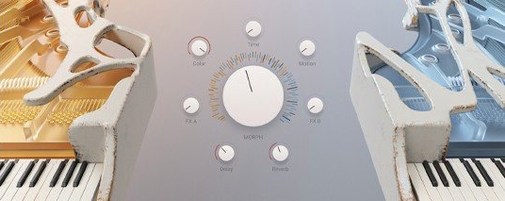
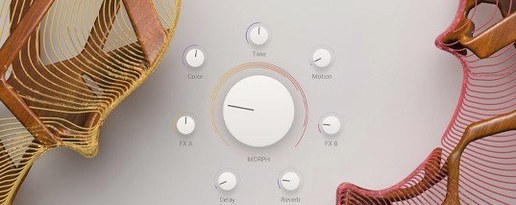
Every preset runs on two independent layers, and each layer carries two sound sources drawn from sampled or synthesized material. The core identity comes from the Morph control: a single knob that crossfades between the layers, or rebalances the sources within them. At one end you get the familiar hammer-and-string attack of a recorded grand; push it toward the opposite position and the tone warps into metallic overtones, bowed-resonance textures, or wavetable sweeps. The transition is continuous, so you can park it halfway for a hybrid that sits well in contemporary composition and sound-design work.
Movement built in
The smart arpeggiator adds rhythmic motion that follows the morph state. It is not an afterthought bolted onto a piano library — the pattern architecture responds to the layered structure of the instrument. With over 300 presets covering both familiar and transformed piano tones, the starting points are already mapped out. The plug-in runs standalone or inside a DAW, making it available whenever a mix calls for a piano that arrives as one thing and leaves as another.
Under the hood during a session
Loading the plug-in inside Logic Pro on an Apple Silicon machine takes roughly three seconds from a cold start, with preset changes snapping in under half a second. That kind of speed holds even when the arpeggiator is running and the Morph knob is being automated in real time. CPU draw stays modest: a single instance hovers around 12–15 percent on a performance core while playing six-note chords with both layers active and the sustain pedal down. Memory use sits near 680 MB with a full multisampled layer loaded, which is lean for an instrument that packs sample content and a synthesis engine into one window.
Stability across a long arranging day has been uneventful. No crashes during plugin scans, no dropouts when swapping between the standalone app and the AU version inside Ableton Live, and no clicks when MIDI mapping the macro controls to a hardware controller. The instrument appears to handle buffer sizes down to 128 samples without audible artifacts, which makes it viable for tracking in a project that is already carrying a dozen other virtual instruments.
Degrading a piano from natural to mechanical for a film cue
A film scoring cue called for a piano entrance that starts natural and degrades into something mechanical by the second verse. The session went like this:
- Opened an instrument track in Logic and loaded Augmented Grand Piano as an AU instrument.
- Scrolled through the preset browser to Felt and Rust, a patch that layers a soft hammer sample with a metallic wavetable source.
- Set the Morph knob to roughly 20 percent — enough felt warmth to read as a piano, with a faint edge of grit starting to peek through.
- Recorded the part with a weighted MIDI controller, using velocity to trigger the softer sample layers while keeping the expression pedal mapped to the Morph parameter.
- During playback, rode the expression pedal progressively toward 90 percent morph, letting the tone shed its acoustic identity as the scene darkened.
- Engaged the arpeggiator on a second instance for a shimmering background pattern, synced to the project tempo at 72 bpm, and blended it low in the mix.
- Bounced both instances to audio stems for the mixer — total time from plug-in launch to stem export: under twenty minutes.
Shows up reliably as a VST3, AU, and AAX in busy templates
Augmented Grand Piano behaves like a team player in a busy template. It shows up reliably as a VST3 in Cubase, an AU in Logic, and an AAX in Pro Tools, and the standalone application stays out of the way when you just want to sketch ideas without launching a full DAW. MIDI learn is quick: right-click any macro, move a hardware knob, and the mapping sticks across sessions.
On the macOS side, it integrates with Core Audio without demanding a separate bridge or Rosetta translation on Apple Silicon — the binary runs natively on ARM and x86. That means it slots into a larger production stack alongside Spitfire libraries, Kontakt instances, and heavy processing chains without forcing a drop in the sample buffer. Producers who grab an Arturia Augmented Grand Piano Mac torrent often discover that the instrument's real value is how little friction it adds to a session, not just the sound library itself. The expanded panel, tucked behind a single click, keeps deep modulation routing and layer tweaks available without cluttering the main performance view.
For sound designers building game soundscapes, the instrument pairs naturally with a convolution reverb on a send channel — the synthesized layer reacts to long decay tails in ways a purely sampled piano cannot. Composers working on library music can stack a dry instance with a second one running a fully morphed pad patch, then group them in a track stack for one-fader control. The plugin does not try to be a mixing environment; it delivers a signal that takes well to external processing, which is exactly what a busy session needs.
Arturia has released version 2.0.2.6369 of Augmented Grand Piano. The update appears in the official downloads and resources pages for the instrument.
- macOS 11.0 or later
- Intel or Apple Silicon Mac
- Version
- 2.0.2 (6369)
- Download
- 2.6 GB
- Developer
- Arturia
- Languages
- English
- Activation
- K'ed by MORiA
- Compatibility
- macOS 11 or later
- Architecture
- Apple Silicon, Intel 64-bit
Questions readers asked
It is a software instrument from Arturia that combines sampled piano recordings with synthesis, letting you morph between realistic and transformed piano textures.
Sign in or open a desk account to write a letter.
No letters on this brief yet. They are read before they run.



 Top
Top