


Arturia Efx AMBIENT 1.0.0 Mac
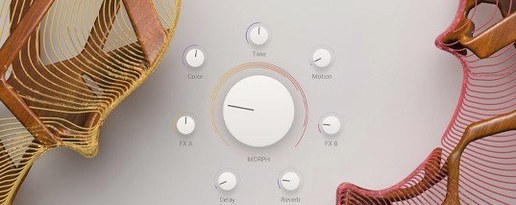
A film composer needs a drone to slowly dissolve into a wash of pitch-shifted harmonics while an editor drags two fingers across a trackpad. Those gestures land directly on Efx AMBIENT's 2D Macro control, bending the room around a scene.
Format and host compatibility
The plugin ships as VST, Audio Unit and AAX, covering the major Mac DAWs. It runs on Apple Silicon and Intel Macs and requires macOS 10.10 or later, according to Arturia's current downloads listing.
Six modes for spatial shaping
The effect splits its engine into six operating modes. One group handles detailed sound deformation, carving noise, reverb tails and grain-like textures, while the other set focuses on pitch shifting for pads that move through intervals as they decay.
Built for pads and cinematic work
Arturia designed the plugin for ambient pads and cinematic effects, pairing a straightforward control set with the expressive 2D Macro so a single drag can crossfade between completely different spatial states.
Right-click the macro ball to snap it back to centre
Right-click the 2D Macro ball and it snaps back to centre instantly — faster than dragging it and more precise than double-tapping when you want to reset a long fade to neutral. The six mode labels along the top edge are clickable shortcuts themselves; bypassing the central selector knob shaves a second off patch browsing and makes it feel closer to a hardware preset bank.
The Advanced panel hides several quality-of-life features behind its fold-out arrow. A wet/dry lock keeps the blend ratio fixed while you scroll through modes, so an A/B comparison between the blurred texture mode and the reverse playback mode doesn't derail every time you switch. Output trim sits at the end of the chain with a clip indicator that flashes early enough to catch transient spikes before a limiter downstream would clamp them. The input section also includes a subtle high-pass filter that lives outside the effect engine; rolling off low-end rumble before it hits the Feedback Delay Network keeps the bottom octave from turning into mud, especially on field recordings dropped into a cinematic timeline.
It slots into your existing Arturia folder right away
A stable directory structure matters when a plugin ships as part of a larger collection. Efx AMBIENT installs into the standard Arturia folder alongside other effects from FX Collection 6, and the stand-alone engine that handles preset browsing shares the same authorization method as the rest of the line. Users asking whether it adds a separate background service will find one lightweight Arturia Software Center process that handles licence checks across all installed titles, not a per-plugin daemon.
Latency depends entirely on the parent DAW's buffer and the active mode. The spectral processing and Feedback Delay Network algorithms run on the CPU rather than a DSP chip, and on a 2021-or-later M1 Pro the plugin typically reports between two and four milliseconds at a 128-sample buffer — low enough for live input through a MIDI controller. A few producers on audio forums have asked about compatibility with older sessions: the plugin reads standard VST3 and AU state data, so recalling a preset from a collaborator who rendered with an Intel Mac does not break the chain on Apple Silicon.
A sound designer drags the mode to blurred texture on a piano stem
A sound designer opens a half-finished cue in Logic Pro and drops Efx AMBIENT onto a return track carrying a dry piano stem. The first step is dragging the mode selector to the blurred texture engine, then pulling the 2D Macro downward and left until the transient attacks smear into a soft granular wash. A quick right-click resets the Macro while the Advanced panel is opened to push the feedback up to roughly 60 percent — just short of self-oscillation — and to set the internal modulation rate to a dotted eighth note, synced to the host tempo.
The second step layers pitch shifting. Switching to a mode that stacks two pitch voices a fifth and an octave above the input turns the wash into a shifting harmonic pad. The designer rides the Macro horizontally during a four-bar transition, crossfading from the clean pitch-shifted tail back toward the blurred texture. A volume automation lane on the return track brings the effect in over three seconds and ducks it before the next cue's downbeat.
The third step involves the reverse playback mode. A short segment of the piano stem, bounced in place and treated with a separate instance of the plugin, runs backward through the Feedback Delay Network with the wet/dry lock disengaged, blending the reversed grains with the dry forward signal. The output clip indicator blinks once on a snare hit, so the trim knob is nudged down two decibels. The whole session — one dry source, three instances, no additional reverb — takes about six minutes from insert to rough mix.
Where Supermassive stops at time-based wash, this moves into granular
Valhalla DSP's Supermassive covers a narrower slice of the ambient spectrum, concentrating on huge modulated delays and reverbs with a single-screen interface that rewards quick knob turns. Efx AMBIENT pulls ahead when a track needs more than time-based wash: the pitch shifting and reverse playback modes open doors Supermassive does not attempt to reach, though Supermassive's feedback algorithms remain a go-to for vocal throws where you want a single giant tail without touching a grain engine.
Soundtoys Crystallizer approaches similar territory through granular pitch-shifted echoes, and its slicing controls give surgical access to delay time and pitch interval. Where Crystallizer excels at rhythmic, repeatable crystal patterns, Efx AMBIENT is built for continuous motion and spatial drift. The 2D Macro alone makes it the better pick for real-time automation across multiple parameters; Crystallizer rewards static, carefully tuned settings more than sweeping performance gestures.
Eventide's Blackhole reverb specializes in the kind of deep, pitch-stable ambience that Efx AMBIENT's blurred texture mode can approximate but not fully replicate. A composer who needs a string quartet to float in a cathedral-sized space with no pitch modulation might reach for Blackhole first. As soon as the brief calls for shifting intervals, reversed grains or a single control that morphs through three effect states during a scene transition, Efx AMBIENT covers more ground from one plugin window.
Initial release. Version 1.0.0 delivers the full six-mode spatial effect engine with 2D Macro control and runs on macOS 10.10 and later on both Intel and Apple Silicon Macs.
- macOS 10.10 or later
- Intel or Apple Silicon Mac
- VST, Audio Unit, or AAX host
- Version
- 1.0.0
- Download
- 285 MB
- Developer
- Arturia
- Languages
- English
- Activation
- K'ed by MORiA
- Compatibility
- OS X 10.10 or later
- Architecture
- Apple Silicon, Intel 64-bit
Questions readers asked
Yes, it is included in Arturia's FX Collection 6 alongside other creative effects.
Efx AMBIENT has six distinct operating modes split between sound deformation and pitch shifting tasks.
Sign in or open a desk account to write a letter.
No letters on this brief yet. They are read before they run.




 Top
Top