

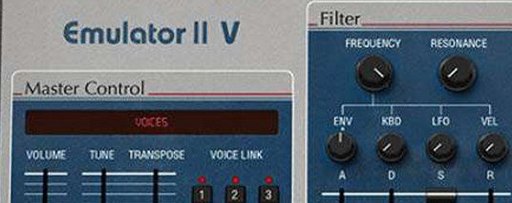
Arturia Emulator II V 1.6.2 Mac
Arturia Emulator II V is a software recreation of the E-Mu Systems Emulator II, an 8-bit sampler that left a grimy fingerprint on countless 80s records.
How does the raw conversion path color the sound?
The signal runs through a model of the original's 8-bit companding and 27.7 kHz sample rate. That conversion chain introduces the grainy aliasing and noise that smears transients and pushes sounds back into a mix, rather than sitting on top of it.
What do the layer controls bring to a patch?
Each of the 8 multitimbral layers carries its own VCF, ADSR envelope, LFO, and VCA with a dedicated ADSR. Stacking a percussive attack from one layer against a swelling pad on another builds complex, shifting textures from a single key press.
Where does the modern modulation fit in?
Extra modulation routings and effects sit downstream from the vintage signal path. Routing a slow triangle-wave LFO to the sample start point while running the output through a chorus model adds pitch-wobble and width without cleaning up the core 8-bit character.
Broader palette than 12-bit crunch machines
Compared to Inphonik RX950, a stripped-down emulation of the Akai S950, Emulator II V leans into a broader palette. RX950 nails the 12-bit crunch of late-80s hip-hop and house with fewer moving parts — a single filter, basic envelopes, and a tight focus on drum-loop degradation. Emulator II V spreads its net wider, pairing the Emulator's signature grit with a multi-layer architecture and a modulation system that feels designed for pads and evolving textures rather than strictly beat work. Where RX950 is a scalpel, Emulator II V is a toolbox with more trays open.
TAL-Sampler from Togu Audio Line models several vintage sampler engines under one roof, including an Emulator II mode. Switching between DAC types on the fly is TAL-Sampler's strongest card, and its modulation matrix runs deep. What Emulator II V holds over it is focus. Because Arturia models only one instrument's full signal path — preamp, companding, output stage — the knobs pull a narrower, more specific set of sounds. With TAL-Sampler, you build the character; with Emulator II V, the character is baked in and you push against its edges.
Against IK Multimedia SampleTron 2, the comparison shifts by era. SampleTron 2 recreates tape-based playback, all flutter and saturated hiss, with a Mellotron-centric library. Emulator II V trades tape warble for digital aliasing and clock noise — a different decade's dirt. Producers chasing the wobbly psychedelic decay of a Chamberlin will get more from SampleTron 2. Those hunting the brittle, grainy bite of early digital sampling will find Emulator II V the sharper tool.
Synthwave producers lean on factory pads and basses
Three camps tend to reach for this instrument first.
Synthwave and retro-electronic producers mine the factory library for pads and basses that slot into a mix without additional processing. The 27.7 kHz sample rate does the low-pass filtering for them, rolling off highs in a way that a DAW EQ can approximate but rarely duplicate.
Sound designers working on film and game scores exploit the layer architecture. Loading a glassy chime into one layer and a field-recording snippet into another, then crossfading with velocity, yields a hybrid texture that shifts timbre under different playing dynamics — useful for underscoring transitions in a scene without stacking three separate tracks.
Hip-hop producers with a crate-digging instinct treat Emulator II V as an alternative to hunting down a working hardware unit. Loading their own drum breaks or vocal chops through the companding model adds the kind of crunch that usually requires an outboard sampler and a stack of floppy disks.
A beatmaker's evening with Emulator II V
A lo-fi hip-hop producer sits down with a dusty Rhodes chord stab ripped from vinyl. She drags the sample into Emulator II V and sets the sample rate to the original 27.7 kHz model. The top end folds into a fizzy haze immediately. She dials the filter cutoff down to 2.4 kHz, adds a touch of resonance, and routes a slow random LFO to the filter — the chords now breathe with an unpredictable warble that feels like a tape machine with a slipping belt. A second layer gets the same sample pitched down an octave, low-passed further, and gated to a short decay. Together, the two layers pulse in and out of each other. She prints the result to a stereo track, chops it into eighth-note segments, and arranges a two-bar loop. The whole process — from loading the sample to printing the loop — takes eight minutes. No hardware sampler to route cables to, no floppy disk to eject.
- macOS 11 or later
- Intel or Apple Silicon processor
- Version
- 1.6.2 (5305)
- Download
- 700 MB
- Developer
- Arturia
- Languages
- English
- Activation
- Included
- Compatibility
- macOS 11 or later
- Architecture
- Apple Silicon, Intel 64-bit
Questions readers asked
The software expands polyphony to 32 voices, a significant jump from the original hardware's limitations.
Sign in or open a desk account to write a letter.
No letters on this brief yet. They are read before they run.


 Top
Top