

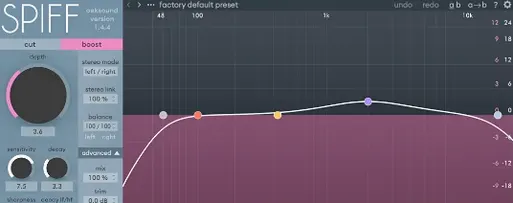
oeksound Spiff 1.4.4 Mac
oeksound Spiff is an adaptive transient processor that cuts or boosts the detail in a signal without splitting the audio into fixed frequency bands. The plug-in analyzes incoming audio to detect transients and lets an engineer move sounds forward or backward in a mix while preserving perceived loudness.
Runs natively on Apple Silicon with AU and AAX builds
Spiff ships as VST, VST3, AU, and AAX on macOS. The AAX build requires Pro Tools 11 or later. According to oeksound, Intel Mac support runs up to macOS 15 Sequoia, and the plug-in also runs natively on Apple Silicon. The current version, 1.4.4, addresses playback overloads in Logic when the GUI first opens and fixes automation misbehavior in Pro Tools after mod-key parameter clicks, alongside a handful of minor corrections.
What the processor does
Because Spiff works on transients directly rather than splitting the spectrum, it can restore liveliness to an overcompressed recording or add expression to an instrument without the phase artifacts that multiband designs sometimes introduce. On vocal tracks, the same detection engine cuts clicks and unwanted mouth noises. The interface presents a straightforward set of controls for transient emphasis or reduction, and the manual is delivered in English.
A session in three moves
Load Spiff onto a fingerpicked acoustic guitar track that sits too far back in the verse. Start with the Cut mode and pull the main fader down to about −6 dB — just enough to soften the pick attack without killing the note body. The waveform display shows transient activity in real time, so you can dial in the Delta switch to hear only what’s being removed. Once the scraping edge is gone, switch to Boost on the bridge section and push the same fader up a few decibels. The guitar jumps forward in the soundstage but the RMS meter barely budges. Add a touch of the Release control to let the transient tail breathe, and the whole performance feels present without any fader rides on the main channel.
Sensitivity defaults can miss fast snare flams
One early confusion is expecting Spiff to behave like a broadband compressor. If the transient detection seems to miss fast snare flams, check the Sensitivity — it defaults to a middle value that suits vocals and strummed instruments, but tightly played percussion often needs a nudge toward the faster end of the scale. Another friction point is the GUI loading delay in Logic that version 1.4.4 specifically repaired; anyone still seeing a CPU spike when the window first opens should confirm the plug-in was rescanned after the update. On dense master-buss material, over-boosting the Attack control can make transients poke through the mix in a brittle way — back off the boost and let the adaptive analysis do the heavy lifting rather than forcing the level. Finally, Pro Tools users who notice parameter jumps after using a modifier-click should find that the 1.4.4 build resolves the automation glitch without requiring a session rebuild.
Dialogue editors use it to pull lip smacks without thinning voice
Post-production editors who clean dialogue all day lean on Spiff for the de-clicking work that a standard de-esser can’t reach — it pulls out lip smacks and hard consonants without thinning the voice. Mix engineers wrestling with oversquashed stems from a client’s rough bounce use the plug-in to excavate transient detail that multiband expansion tends to smear. Live-instrument producers working outside heavily quantized projects value the expressiveness it returns to string and percussion tracks, especially when the arrangement is dense and every element needs a clear pocket. Anyone running the oeksound Spiff Mac full version on an Apple Silicon machine gets the benefit of the native processing path, and the plug-in’s single-interface design means less time clicking between bands and more time making decisions.
Version 1.4.4 fixes playback overloads in Logic that could occur when the plug-in window first appeared. Pro Tools users also get corrected automation behavior after mod-key parameter clicks, and the release includes several minor improvements.
- macOS 10.14 Mojave or later
- Intel and Apple Silicon support
- VST, VST3, AU, AAX (Pro Tools 11 or later required for AAX)
- Version
- 1.4.4
- Download
- 140 MB
- Developer
- oeksound
- Languages
- English
- Activation
- K'ed by FLARE
- Compatibility
- macOS 10.14 or later
- Architecture
- Apple Silicon, Intel 64-bit
Questions readers asked
Yes. Spiff's transient detection can identify and reduce clicks and other short vocal noises without manual editing.
Sign in or open a desk account to write a letter.
No letters on this brief yet. They are read before they run.






 Top