

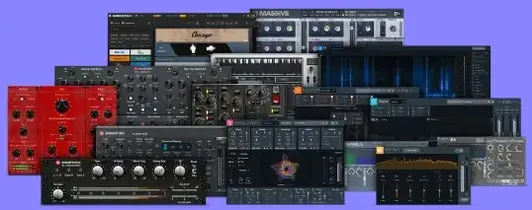
Plugin Alliance Brainworx Bundle 2025.06.16 Mac
Anyone who has reached for a single Brainworx EQ on a vocal knows the sound. The bundle collects that same codebase into one set of tools, and as of version 2025.06.16 it runs on both Intel and Apple Silicon Macs with macOS 11 or later. Plugin Alliance describes Brainworx as one of its founding development partners, and the bundle shows why that partnership has lasted.
bx_2098 EQ shapes drums and guitars without sounding processed
bx_2098 EQ is the workhorse here. It sits well on drums and guitars, where its curves can reshape a sound without making the track feel processed. bx_rockrack V3 handles guitar tones in a mix context, giving a cab-and-amp chain that responds more like hardware than a static preset.
On buses and the master
bx_masterdesk Pro is built for the end of a session. Its job is glue and level, not surgical fixes, so it fits on a drum bus or the stereo output. Using the bundle across a session means one installer, one license set, and a consistent sound from track to master.
A rock mix comes alive with EQ and amp chains before printing
Picture a late morning. Coffee is still warm. A rough mix of a rock track sits in Logic, drums hitting, bass rumbling, guitars panned wide, vocal waiting for a place to sit. Nothing is printed yet.
The first move is on the drum bus. I open bx_townhouse Buss Compressor, set the attack slow and the release fast, then pull the threshold until the needle dips four decibels on the snare hits. The kick tightens, the cymbals breathe, and the room mics suddenly feel like they belong to the same performance. That compressor does one thing — British-style bus glue — and it does it without making you think about it.
Next, the bass. bx_bassdude opens on the DI track. The amp model defaults to a clean, round tone, but dialing the gain up to edge-of-breakup gives the low end some hair without losing the fundamental. A small boost at 800 Hz from the onboard tone stack helps the bass cut through the guitars before I even touch an EQ.
On the vocal channel, bx_2098 EQ replaces the stock channel strip. I pull 3 dB at 400 Hz to clear some boxiness, add a shelf at 10 kHz for air, and leave the mids flat. The vocal sits forward without sounding separate from the band. The EQ curve looks gentle on screen, but the change is immediate in headphones.
By early afternoon, the mix has shape but no finish. bx_masterdesk Pro goes on the stereo output. The foundation knob adds low-end weight without clouding the kick; the tone control tilts the top end open. A small adjustment on the de-esser catches a harshness on the guitar bus that I had missed earlier. Two knobs, three minutes, and the mix translates to a Bluetooth speaker sitting on the desk.
The final pass is a quick check with bx_glue on a parallel compression bus for the vocals. Blend it in low, maybe 30 percent, and the lead vocal gains density without losing dynamics. Save the session, bounce a reference, and send it off. The whole plugin set feels like a console in a box, but one where each module remembers what it is supposed to do.
Brainworx favors console color over FabFilter's surgical visuals
Stack the Brainworx bundle against FabFilter's individual processors and the differences are philosophical, not just technical. FabFilter plugins prize visual feedback — Pro-Q 3 gives you a spectral display that invites surgical moves, and Pro-C 2 shows gain reduction curves that practically beg for precise tweaking. The sound is clean and modern, and the interfaces reward engineers who think in terms of exact values. The Brainworx approach is more tactile. bx_2098 EQ does not show you a real-time analyzer. It expects you to listen, turn a knob, and trust the result. Neither way is wrong, but the working speed differs.
Compared with Waves' Abbey Road and SSL collections, the similarity is in the modeling philosophy. Both companies chase the sound of specific hardware, down to the quirks of transformers and gain staging. Where they diverge is in breadth. A Waves collection might give you one channel strip and one compressor; the Brainworx bundle spreads across EQs, dynamics, amp sims, and mastering tools in one package. The trade-off is that Waves bundles can be lighter on CPU, while Brainworx models sometimes demand more cycles — but the harmonic complexity in a plugin like bx_console AMEK 200 justifies the hit on a mix bus.
Against Universal Audio's UAD lineup, the comparison gets interesting. UAD plugins historically relied on DSP hardware, though native versions are growing. Brainworx runs entirely native, which means no extra hardware on the desk. Sonically, both companies model consoles with obsessive detail. bx_console SSL 4000 E captures the punch of an SSL E-series desk with the same dedication that UAD brings to its own SSL models. The difference is that the Brainworx version includes the TMT (Tolerance Modeling Technology) across channels, so every instance of the plugin on a console-style mix behaves slightly differently, like the real desk would.
Real-world scenario: a podcast post-production chain
A spoken-word editor handling a weekly interview podcast faces a particular problem. The host records in a treated studio, but guests dial in from laptops, phones, and conference rooms. The raw tracks arrive with wildly different tonal balances — one guest sounds like they are in a broom closet, another is thin and sibilant, a third has air-conditioning hum baked into the file.
The editor opens bx_digital V3 on the first guest track. The mid-side processing separates the voice (center) from the room reflections (sides). A low cut on the side channel reduces the boxiness of a small untreated room without touching the voice itself. The mono-maker sums frequencies below 120 Hz to tighten the low end, and the presence band adds just enough clarity to pull the guest forward in the mix. The same plugin instance fixes three problems in under a minute.
On the host track, bx_console AMEK 200 brings a bit of console saturation. The THD control adds gentle harmonic density that makes the host's voice feel more present on earbuds, where most listeners will hear the episode. The channel compressor catches peaks that slipped past the clip gain stage, and the expander quiets the noise floor between sentences.
The master bus gets bx_masterdesk Pro, set lightly. The editor is not mastering a pop record; the goal is consistent loudness for streaming platforms and a tonal balance that survives in a car or on a kitchen speaker. The final episode exports at the target LUFS with no extra loudness penalty from the platform. The whole post chain uses three plugins total, and the second episode of the batch goes faster because the presets save with the session template.
The SSL 4000 E channel breaks when you treat it like a clean digital EQ
The most common slip is treating bx_console SSL 4000 E like a clean digital EQ. New users see the familiar four-band layout and start cutting and boosting as if it is a parametric plug-in with no character. The SSL channel strip imparts a tonal signature even at neutral settings — the line amps and the filters have a sound. Pushing 10 dB of high shelf on a vocal without checking the gain staging often results in a brittle, harsh top end that no amount of de-essing can fix. The better approach is to set the EQ first, then adjust the channel input gain until the level hits the compressor threshold naturally.
Another early mistake involves bx_masterdesk Pro on individual tracks. The plugin is designed for buses and the stereo output, not for slotting onto a snare drum. Beginners sometimes drop it onto a single channel, hear the foundation knob blow up the low end, and dismiss the plugin as heavy-handed. It is heavy-handed because it is a mastering processor expecting a full mix. On a kick drum, the same knob adds sub frequencies that clash with the bass and muddy the arrangement.
Overloading the TMT channels is a subtler trap. bx_console AMEK 200 offers dozens of unique channel variations, each modeling a different physical channel on the original desk. A beginner might assign a different TMT channel to every track in a 48-track session, chasing analog randomness. The result is often a diffuse stereo image and inconsistent summing. A handful of channels — maybe four or five across the entire mix — gives enough variation to feel alive without losing the cohesion that a real console imposes by having a limited number of channels in the first place.
- macOS 11 or later
- Intel or Apple Silicon Mac
- Interface language: English
- Version
- 2025.06.16 Fix
- Download
- 2.1 GB
- Developer
- Plugin Alliance
- Languages
- English
- Activation
- K'ed by TEAM HCiSO
- Compatibility
- macOS 11 or later
- Architecture
- Apple Silicon, Intel 64-bit
Questions readers asked
The bundle contains multiple Brainworx plugins, including bx_2098 EQ, bx_masterdesk Pro, and bx_rockrack V3.
Yes, the current version supports both Intel and Apple Silicon Macs running macOS 11 or later.
Sign in or open a desk account to write a letter.
No letters on this brief yet. They are read before they run.






 Top
Top