

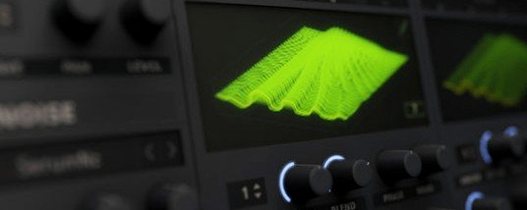
Serum 2.0.24 Mac
Up to 16 voices can be stacked on a single oscillator in Serum 2.1.5, the wavetable synthesizer from Xfer Records. The synth builds on the original's real-time wavetable editing with expanded modulation routing and a set of filters borrowed from the developer's own LFOTool.
Where Serum fits in a Mac producer's setup
- Sound design duties. Import, edit and morph wavetables directly in the interface. The visual feedback makes custom patch creation a direct, hands-on process.
- Bass and lead reinforcement. Stack settings layer octaves and intervals so a single key press triggers a thick, multi-voice signal without duplicating tracks.
- Movement and texture. Flangers, phasers and comb filters can track the played musical note, turning simple chord stabs into shifting harmonic beds.
Advanced unison and modulation
Each wavetable oscillator carries its own advanced unison parameters. Combined with the stack settings, the result is a wide, animated stereo image that stays controllable. The modulation system ties everything together, letting producers route envelopes, LFOs and macros to nearly any destination inside the instrument. Xfer Records calls the synth a unique blend of sound generation methods, and that blend shows most clearly when Serum sits between a drum machine and a utility chain in a typical Mac session.
Mistakes newer producers make right out of the gate
Loading Serum and flicking through presets is fine, but the first real stumble is ignoring the wavetable editor entirely. The display isn't just a visualizer; click and drag directly on the waveform window to reshape harmonics. Producers who treat it like a static waveform player miss half the engine.
Another common misstep is stacking unison voices to maximum and calling it width. Sixteen voices per oscillator sounds huge in solo, but in a mix it turns into phase soup. Dialing back to five or seven voices and using Unison Warp to detune only the outer voices keeps the stereo spread without losing the fundamental. Unison WT Pos, which assigns a different waveform to each unison voice, works best with subtle wavetable offsets, not radical jumps between frame positions.
Beginners also sleep on the dual filter routing. Serum lets you run filters in series, parallel, or split by oscillator. The serial path into a comb filter that tracks pitch creates plucked resonances that follow the keyboard, a sound that's easy to miss if both filters stay in parallel mode.
Curb CPU spikes by killing onboard effects on bus-fed instances
The most frequent headache is CPU spiking when multiple instances run with high unison counts. The fix isn't always reducing voices. Turn off the built-in effects on instances that sit in a bus with external reverb or delay; the on-board flanger and phaser are quality blocks but they eat cycles. Also, lowering the oversampling setting in the global tab cuts processor load noticeably on Intel machines, and the difference is often inaudible once the track is full of other elements.
Another sticking point is preset management. Serum stores its presets inside its own folder structure, not in the DAW's library. If a user drags the Serum component file without moving the preset folder, every saved patch goes missing. The preset folder lives in /Library/Application Support/Xfer/Serum Presets/. Dropping user banks anywhere else means the browser shows nothing. The same goes for custom wavetables: Serum expects them in the Tables folder alongside Presets, and subfolders are fine as long as they sit in the right parent directory.
On Apple Silicon Macs, some DAWs launch the Intel version of Serum through Rosetta unless the host runs natively. Check the DAW's own architecture setting first. If Serum's interface feels sluggish or the waveform display stutters, the plugin is likely running translated. A native ARM build is included in the 2.1.5 package, and swapping it in clears up the lag immediately.
How Serum compares with similar Mac synths
Next to Vital, Serum's closest conceptual cousin, the difference comes down to the filter section. Vital offers a capable set of filter models, but Serum's LFOTool-derived filters, the sample-rate reduction as a filter process, and the dual filter routing with switchable configurations give it an edge in aggressive sound shaping. Vital's modulation system is strong, yet Serum's macro mapping feels tighter for live performance, especially when assigning multiple destinations to a single knob with individual curve adjustments per slot.
Against Arturia's Pigments, Serum is less of a multi-engine workstation. Pigments piles on granular, additive, and harmonic engines alongside wavetable and virtual analog. That breadth is impressive, but it also means more tabs, more menus, and a steeper climb to master each section. Serum stays focused on one oscillator architecture and pushes it deep. The unison stack settings that layer octaves from a single key press are something Pigments handles differently, requiring separate engines or layers to approximate the same effect. Producers who want one synth that does a bit of everything may lean Pigments; those who live inside wavetables tend to stick with Serum.
Phase Plant, by Kilohearts, is a modular playground where oscillators, filters and effects snap together like blocks. It's more flexible in theory because you can add as many generators as the CPU tolerates. In practice, Serum's quick modulation assignment by drag-and-drop and its immediate wavetable visual feedback make patch creation faster for most routine sound design tasks. Phase Plant rewards planning; Serum rewards impulse.
Serum runs natively on Apple Silicon—no Rosetta required
Does it work on an M1 or M2 Mac without Rosetta? Yes. The version 2.1.5 package includes a native ARM build. If the DAW itself runs natively on Apple Silicon, Serum loads as ARM. The waveform display and filter processing are fully optimized, not translated. Users on older Intel machines or those running DAWs still under Rosetta will see the x64 build load instead.
Will it open old Serum 1 patches? Serum 2 reads every preset created in the original version. The wavetable format hasn't changed, and the modulation architecture is backward compatible. A patch built in Serum 1 loads with its routing intact, though the new filter types and stack features won't be present unless added manually after loading.
Does it run as a standalone or only inside a DAW? Serum is a plugin, not a standalone application. It loads inside any host that supports VST3 or AU formats. Logic Pro, Ableton Live, FL Studio on Mac, Bitwig, and Studio One all recognize it without extra configuration. There is no standalone executable included.
How heavy is the download and what gets installed? The package contains the plugin file, the factory preset library, and the core wavetable collection. The preset and wavetable folders land in Application Support, and the plugin component or VST3 file goes into the standard system directories. Everything stays self-contained; no background services or license managers run after installation.
Is it stable on older macOS versions? The stated minimum is macOS 10.13. Reports from users on High Sierra and Mojave indicate solid performance, though the native ARM build only applies to Big Sur and later. On 10.13 through 10.14, the Intel build is the only option and runs as expected.
Building sci-fi ambiences that sound organic for an indie game
Consider a sound designer building a library for an indie game soundtrack. The brief calls for sci-fi ambiences that still feel organic, something between a malfunctioning reactor and wind through metal grating. The designer opens Serum on a MacBook Pro, loads a basic sawtooth wavetable, and immediately heads to the wavetable editor. Using the formula functions, she applies spectral morphs that turn the clean saw into a jagged, inharmonic shape over about 20 frames. She assigns an LFO to the wavetable position with a slow, randomized rate, so the timbre never repeats exactly the same way twice.
Next, she routes the signal through a comb filter set to track the keyboard, tuning its resonance to a low E that hums like a distant engine. A second filter, a phaser, sits in parallel and sweeps at a different speed, adding the metallic whistle. Unison is set to three voices with Unison Warp applying subtle detune only to the outer voices, keeping the center voice solid so the patch doesn't collapse to mono on small speakers. The stack setting layers a sub-octave at low volume, reinforcing the weight without muddying the midrange texture. By the time she maps the filter cutoff and wavetable position to her MIDI controller's knobs, the patch responds to performance gestures with a life of its own. The whole session, from blank init to finished ambience, runs inside 20 minutes without leaving a single plugin window.
Serum 2.0.24 lands with a stack of host-specific fixes and a few workflow refinements. A new Ignore VST3 Note IDs setting sidesteps note-identifier quirks in certain hosts, while Pro Tools users gain support for automatable parameter shortcuts.
The update corrects data loss when opening projects and sessions saved in newer Serum 2 builds. Digital Performer sees three fixes: pop-up tooltips now display correctly, periodic crashes are resolved, and interface scaling in JUCE-based hosts behaves properly when Windows Display Scaling is not at 100%.
Elsewhere, ACIDized WAV files with empty strc chunks load as expected, Clip Player macro automation updates reliably in Bitwig Studio, and MPE values are preserved after voice stealing. The Piano Roll note preview now respects incoming velocity. A potential crash triggered by malformed data sent to Serum’s processor has been patched, and the preferences interface—broken since version 2.0.22—is restored. Preset browsing with the Previous/Next buttons no longer incorrectly selects ARP – Aardvark after loading a session. A Pro Tools hang on shutdown in Windows has also been fixed.
- macOS 10.13 or later
- Apple Silicon or Intel 64-bit processor
- Version
- 2.0.24
- Download
- 30 MB
- Developer
- Xfer
- Languages
- English
- Activation
- k'ed by Team V.R
- Compatibility
- macOS 10.13 or later
- Architecture
- Apple Silicon, Intel 64-bit
Questions readers asked
Serum is a wavetable synthesizer built for creating, importing, editing and modulating wavetables in real time.
A single oscillator can stack up to 16 voices, and stack settings let you layer notes such as octaves to make one pressed key sound fuller.
It includes filter types found in LFOTool plus additional flangers, phasers and comb filters that can track the played musical note.
Sign in or open a desk account to write a letter.
No letters on this brief yet. They are read before they run.







 Top
Top