

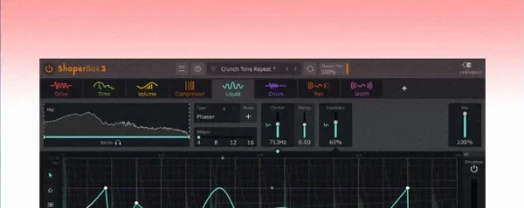
ShaperBox 3.6.1 Mac
Version 3.6.1 lands with a handful of fixes and automation upgrades. PitchShaper's Formant Link, Density, and Grain Size controls can now be automated, putting more real-time modulation within reach. The update also removes an audio artifact triggered when a MIDI note or Audio Trigger event hit a silent input, and squashes a quirk where the cursor would vanish in Logic Pro after dragging a control.
Beneath those maintenance notes, the engine rewards an experienced hand. The Audio Trigger system listens for transient information across the full frequency range and lets you fire multiple trigger sources simultaneously—gate a reverb wash from a kick while ducking a delay with a snare, all inside one instance.
LiquidShaper remains the tool for flanger and phaser textures that track the groove instead of free-running. The sidechain visual display maps gain reduction against the waveform, so dialing in pump and breathing against a silent bus is a measured, visual task rather than guesswork.
The bundled browser carries 600 presets, but the architecture leans toward construction. Building chains that stack time, filter, and pan effects per band often starts with a blank slate and the trigger routing. Support covers Apple Silicon and Intel 64-bit systems running macOS 10.15 and later.
Where kick-bass ducking becomes a single-instance move
Electronic producers working in four-on-the-floor genres tend to click with ShaperBox fastest. The sidechain and volume-shaping tools map directly onto kick-bass relationships, and the multiband routing means a single instance can duck the low end of a bass while leaving the mid-range grit untouched. Mix engineers who handle dense pop or hip-hop sessions report it as a problem-solver for carving space without building elaborate sidechain routing across multiple aux tracks.
Sound designers and post-production editors find a different entry point. The Audio Trigger routing feeds off transient material that has no musical grid to sync to—footsteps, door slams, machine noise—and applies rhythmic modulation to layers that would otherwise require manual envelope work. If you spend half your session drawing automation curves by hand, the trigger engine will likely remove that chore for any gating, filtering, or panning movement you can describe as a timing event.
Interface stays fluid across nine modules
On Apple Silicon machines, the plugin loads fast enough that inserting it mid-session does not stall playback. The interface draws without lag when switching between the nine Shaper modules, though the waveform overview in VolumeShaper can get slightly sluggish when multiple trigger sources are active and the oscilloscope is set to a high refresh rate—something the 3.6.1 update partially addresses with the Anti-Click Trigger Smoothing fix.
Memory use stays modest. A single instance with three active Shaper bands typically sits under 200 MB of RAM. Stacking five or six instances across a busy project is not free, but it is predictable. CPU spikes are more common with the TimeShaper and LiquidShaper effects when grain density or feedback are pushed high, particularly on Intel Macs. Freezing or bouncing those tracks before a full mixdown avoids dropouts during offline rendering.
Plugin scanning in Logic Pro and Ableton Live has been stable across the current build. Users migrating from earlier versions sometimes see duplicate entries in their DAW's plugin list—deleting the older component file from the Library folder clears it.
Common Friction Points
One recurring snag is the Audio Trigger sensitivity when the input signal has long silent gaps. Before 3.6.1, a MIDI note arriving during silence could produce a short burst of noise at the output. The fix is now baked in, but if you run an older project that was saved before the update, reloading the plugin instance resets the trigger calibration to the corrected behavior.
Another issue surfaces with the sidechain routing in some DAWs. When the sidechain source is a bus that also feeds the main output, a feedback loop can form and the gain reduction display will show erratic movement. The solution is routing the sidechain source from a pre-fader send or a dedicated trigger track set to no output.
Preset loading occasionally resets the multiband crossover points to default, discarding custom frequency splits. Saving a user preset after setting the crossover frequencies, then reloading it, locks the band boundaries in place. The factory 600 presets do not always respect your custom routing, so user presets become essential for recall.
Overlooked Shortcuts and Workflow Details
The waveform display in VolumeShaper accepts click-and-drag breakpoint editing, but holding Option while dragging a curve segment mirrors the movement across the opposite half of the waveform—a fast way to build symmetrical ducking shapes without copying and pasting points. Holding Shift while adjusting any knob switches to fine-tuning mode, which is easy to miss since the interface does not advertise it.
MIDI triggering extends beyond simple note-on events. Sending a C3 note toggles the trigger; sending different pitches on consecutive sixteenth notes changes which trigger pattern slot is active—letting you sequence modulation changes from a MIDI clip rather than automating bypass states. A search for shaperbox 3 mac torrent often surfaces alongside questions about this feature on production forums, suggesting many users discover it late or not at all.
The browser's search field filters by keyword across preset names and categories, but typing "kick" also returns results where the word appears in the preset description, not just the title. That doubles the hit count for common searches and is not obvious from the interface labeling. Some producers who grab a shaperbox crack mac find the preset search surprisingly deep once they explore it, with the expanded scope already working this way.
A small but useful detail: right-clicking any band's solo button solos that band across all active Shaper modules simultaneously, not just the current effect. That makes auditioning what the low band is doing across filter, compression, and pan effects a single-click operation. The same right-click on the mute button mutes the band globally, which speeds up troubleshooting when a frequency range suddenly drops out and you need to find which module is responsible.
PitchShaper's Formant Link, Density, and Grain Size controls are now exposed as automation parameters. An audio artifact that appeared when a MIDI note or Audio Trigger event arrived during a silent input has been fixed. A Logic Pro bug that caused the cursor to disappear after dragging a control was also resolved.
- macOS 10.15 or later
- Apple Silicon or Intel 64-bit processor
- Version
- 3.6.1
- Download
- 111 MB
- Developer
- CableGuys
- Languages
- English
- Activation
- k'ed by Team V.R
- Compatibility
- macOS 10.15 or later
- Architecture
- Apple Silicon, Intel 64-bit
Questions readers asked
Yes, version 3.6.1 runs natively on Apple Silicon and Intel 64-bit Macs.
It detects transients in an incoming signal and can trigger any of the plugin's effects, with multiple triggers running at the same time.
LiquidShaper is a built-in module for creating rhythmic flanger and phaser effects that lock to the project tempo.
Sign in or open a desk account to write a letter.
No letters on this brief yet. They are read before they run.




 Top
Top