

Slate Digital Storch Filter 1.0.6 Mac
Version 1.0.6 of Storch Filter requires macOS 11 or later and runs on Apple Silicon. It ships as a VST, AU, and AAX plugin, with the interface in English.
DAWs it runs in and the missing Intel build
The plugin installs in standard VST, AU, and AAX formats, covering most major DAWs on macOS. No separate Intel build is listed for the current release.
What does the filter section do?
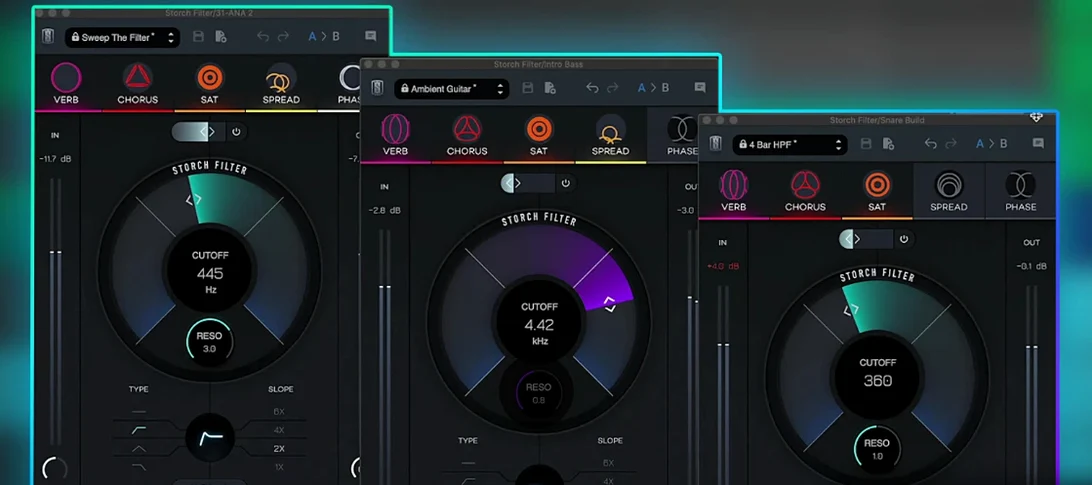
The core is an adjustable low pass filter with cutoff and resonance controls. An autofilter adds six LFO wave shapes for movement without manual automation.
What effects are built in?
Five effects sit alongside the filter: reverb, chorus, saturation, stereo widening, and phaser. Each is linked to the cutoff and resonance controls, so the filter shapes how the effects respond.
Who made it?
The plugin was created in collaboration with producer Scott Storch. The layout keeps the filter and effects on one screen, with controls arranged for quick adjustment.
First days: getting past the presets
The factory presets curated by Scott Storch show off the plugin’s range, but they rarely slot into a mix without adjustment. During the first few days, load a preset, then immediately pull the cutoff back by 20–30 percent. Many presets open the filter wider than a busy arrangement can handle. Dialing it down brings the effect into a usable pocket without losing the character of the preset.
A second habit worth forming early: assign the FX Boost slider to a MIDI controller or automation lane before reaching for any other control. The slider pushes signal into the five effects in parallel, and riding it by hand during a transition or a breakdown often creates movement that the autofilter alone cannot. On an Apple Silicon machine, automation recording is smooth and glitch-free even at buffer sizes down to 64 samples.
Finally, check the signal chain after the plugin. Storch Filter can add a hefty low-end bump when resonance is pushed, especially on 808s or sub-bass parts. Place a spectrum analyser or a metering plugin right after it for the first few sessions; you will quickly learn which cutoff and resonance pairings need a high-pass downstream.
Plugin invisible after install? Check Rosetta 2 mode
DAW does not see the plugin after installation. This happens most often when the host is running under Rosetta 2 while the plugin is ARM-only. Rescan the plugin folders with the DAW in native Apple Silicon mode. If the host offers an “Open using Rosetta” toggle, make sure it is switched off.
Phaser effect creates a sharp midrange whistle at high resonance. The phaser is linked directly to the resonance control, and past roughly 70 percent it can ring on sustained notes. Pull resonance back slightly, or narrow the stereo widening effect, which tends to exaggerate the phaser’s peaks when the two effects run together.
Autofilter sync drifts against a recorded tempo map. The LFO syncs to host tempo, but tempo-map changes in some DAWs can cause a brief wobble at bar boundaries. If you hear it, bounce the filtered track to audio for sections with frequent tempo shifts, or switch the LFO to a free-running rate and dial it in by ear.
High CPU load when multiple instances are open. Each instance of Storch Filter runs the filter core, the five effects, and the LFO engine. On a project with eight or more instances, consider printing the effect to a new audio track once the sound is right. On Apple Silicon, freezing or bouncing a track takes only a few seconds.
How a beatmaker uses it on a loop
A producer working on a trap beat drops Storch Filter onto a melodic loop that sits behind the main 808 and hi-hat pattern. The loop is a dusty Rhodes sample that clashes with the vocal when it plays at full bandwidth. The producer sets the cutoff to 800 Hz, pushes resonance to about 45 percent, and engages the saturation and chorus effects. The saturation warms the Rhodes without adding fizz, and the chorus widens it just enough to leave the centre clear for the vocal.
On the chorus sections, the FX Boost slider is automated to jump from 30 percent to 80 percent over two bars. The reverb floods in as the slider rises, but because it is tied to the filter cutoff, the reverb tail stays dark and never splashes into the high end. The producer then assigns the phaser to a triangle-wave LFO at quarter-note sync, which gives the loop a slow, rolling texture that shifts every beat. The whole treatment turns a loop that was fighting for space into a textured bed that moves with the arrangement. The session stays responsive; the single instance of Storch Filter adds under four percent CPU load on an M1 Pro at 44.1 kHz.
Build 1.0.6 is the current release. No other changes are listed for this version.
- macOS 11 or later
- Apple Silicon
- Interface language: English
- Version
- 1.0.6
- Download
- 69 MB
- Developer
- Slate Digital
- Languages
- English
- Activation
- k'ed by GUISEPPE
- Compatibility
- macOS 11 or later
- Architecture
- Apple Silicon
Sign in or open a desk account to write a letter.
No letters on this brief yet. They are read before they run.


 Top
Top