

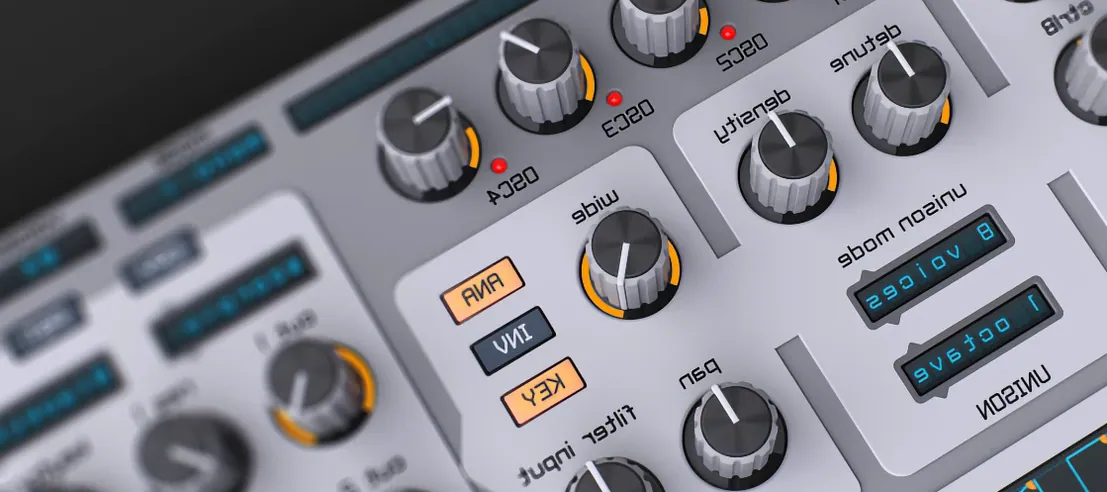
Spire 1.5.19 Mac
If a classic subtractive synth were expanded with modern digital oscillators and a modulation system that connects almost anything to anything else, you'd land somewhere close to Spire. Reveal Sound's polyphonic synthesizer has been a workhorse in production sessions for years, and the current version, 1.5.19, keeps all of that machinery in place without disrupting what users already rely on.
Four oscillators, a wavetable mode, and a modulation matrix ship inside
- Four oscillators with flexible waveforms, including a wavetable mode
- Two LFOs and two ADSR envelopes for shaping movement
- A modulation matrix for routing control signals
- An arpeggiator and a step sequencer for pattern generation
- More than 1500 factory and user presets, loaded through an interface that keeps everything accessible
The sound remains the point
The instrument ships with a large preset library, but the real draw is the routing. The four oscillators can layer, sync, and feed into the dual filters before hitting the effects section. The arpeggiator and step sequencer turn simple chord stabs into evolving phrases without leaving the plugin window. Stability on macOS 10.13 and later is unchanged, with native support for both Intel and Apple Silicon machines.
Switch to Poly mode with eight voices before you strike a key
Out of the box Spire loads with sensible defaults, but a few adjustments make the instrument feel more like your own. First, open the global settings panel and set the voice mode to Poly with at least eight voices if your CPU can handle it. The default four-voice polyphony chokes quickly on sustained pads. Next, disable the onboard limiter unless you are intentionally driving the output stage. The limiter reacts aggressively and can flatten dynamics before a sound ever reaches your DAW mixer.
The modulation matrix ships with four empty slots. Filling just two of them, say by routing LFO 1 to oscillator pitch and envelope 2 to filter cutoff, turns a static preset into something that breathes. Also worth checking: the arpeggiator sync setting defaults to internal clock. Change it to host sync unless you are running Spire standalone, which most producers are not.
They start with a dry Init saw wave and then activate oscillator 2
A producer opens an empty project, drops Spire onto a software instrument track, and starts with the Init preset from the browser. The patch is a single saw wave, dry and unremarkable. That is the point. They activate oscillator 2, tune it up seven semitones, and reduce its level slightly. Already the sound thickens. They switch oscillator 1 to a wavetable waveform and scroll through the table positions until something glassy and digital cuts through.
Next they open the filter section, choose the 24 dB low-pass slope, and pull the cutoff down to about 400 Hz. Envelope 2 gets assigned to the filter cutoff in the modulation matrix with a depth of around 35 percent. The transient now has bite, but the body of the sound stays warm. A short ping-pong delay from the effects rack pushes the stereo image wide without cluttering the centre. They save the patch, name it, and drag a chord progression from the DAW piano roll onto the track. The arpeggiator goes on next: up pattern, two octaves, sixteenth-note timing locked to host tempo. The chords break into a rhythmic sequence that would have taken ten minutes to program by hand.
Sound designers lean hardest on the modulation matrix
Electronic producers working in trance, house, and dubstep get immediate mileage from the factory library, but the people who extract the most from the instrument are sound designers and hybrid-scoring composers. Sound designers lean on the modulation matrix because it routes any source to nearly any destination, including effects parameters, which is rare in a subtractive-style synth. The wavetable oscillator gives them harmonic material that pure analog emulations cannot produce without stacking layers externally.
Composers who blend electronic and acoustic elements benefit from the tight transient control. The two ADSR envelopes, plus the ability to modulate wavetable position with key tracking, mean a patch can sound percussive at low registers and airy at high registers without switching presets. The Mac version running natively on Apple Silicon handles dense arrangements without the CPU spikes that plagued earlier builds, so orchestral hybrid sessions stay responsive even with multiple instances.
Hobbyists who just want to browse presets will still find plenty to use, but the interface rewards those willing to move beyond the browser tab. The learning curve is not steep, but it is real.
Version 1.5.19 runs on Apple Silicon and macOS 10.13 and later
Does Spire work on current macOS versions? Version 1.5.19 runs on macOS 10.13 and later, including Apple Silicon machines, so compatibility is not a concern for most setups. Users searching for spire mac torrent or spire vst mac often ask whether the plugin loads in Logic Pro or Ableton Live. It does, in AU, VST2, VST3, and AAX formats.
Is the CPU load manageable? On Intel machines from the last five years it is moderate. On Apple Silicon it is light. The unision mode and the reverb effect are the two heaviest consumers, so dial those back if you hear crackling. Some users who downloaded a spire torrent or looked for a spire crack report that granting the necessary permissions for unsigned components resolves stability issues.
How long does it take to learn? Someone familiar with subtractive synthesis can build a patch from scratch in under an hour. The modulation matrix adds a second layer of complexity, but the manual is clear and the tooltips inside the plugin are accurate. The preset management system uses standard folder navigation, so importing third-party banks is straightforward.
Reveal Sound's build 5343 corresponds to Spire Synthesizer version 1.5.19. The release maintains compatibility and does not introduce feature changes.
- macOS 10.13 or later
- Intel and Apple Silicon Macs
- Version
- 1.5.19
- Download
- 158 MB
- Developer
- Reveal Sound
- Languages
- English
- Activation
- K'ed by MORiA
- Compatibility
- macOS 10.13 or later
- Architecture
- Apple Silicon, Intel 64-bit
Sign in or open a desk account to write a letter.
No letters on this brief yet. They are read before they run.





 Top
Top