

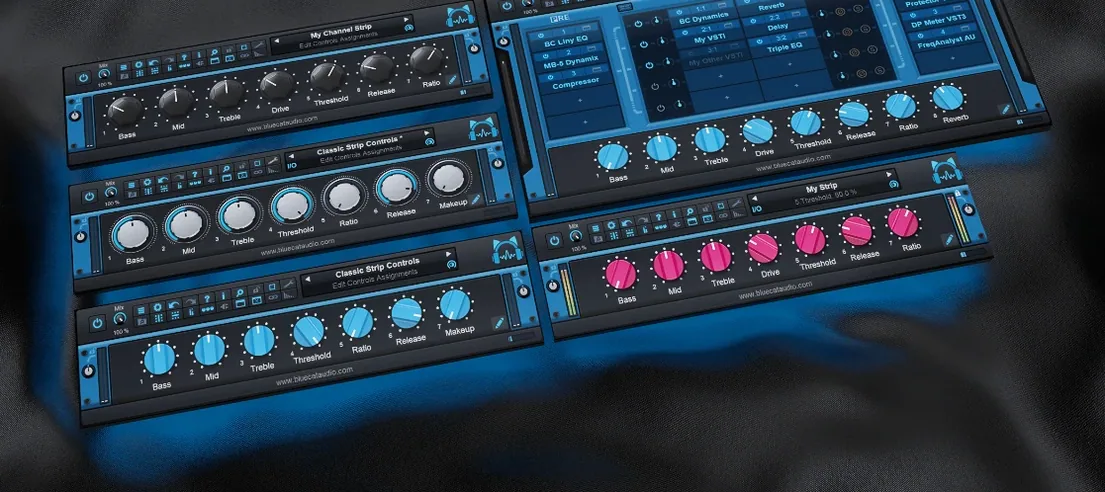
Blue Cat Audio Blue Cats PatchWork 2.7.5 Mac
Blue Cat's PatchWork is a plug-in host and multi-effects patchbay that lets you chain third-party VST, VST3, and Audio Unit plug-ins inside any DAW as if they were a single processor.
The plug-in browser sits at the top of the window with a search field that narrows results as you type. Drag a plug-in into an empty slot and the GUI opens immediately — the 2.75 update added support for dragging user interfaces directly from the file system, so you can organize windows across multiple displays without hunting through menus. Each loaded effect gets its own bypass button, and as of version 2.75 those bypass states respond to MIDI, along with commands to open or close a plug-in's interface on the fly.
Parallel signal paths are set up by connecting slots in the grid, which also hosts Blue Cat's own built-in effects for gain, delay, and basic modulation. When a chain works, you can copy, paste, save, and reload the entire layout — a workflow addition from the 2.75 release. The built-in audio recorder captures up to 16 channels downstream from the processing, so a printed mix of the chain lands directly on disk.
Keyboard shortcuts are sparse but a few small conveniences save real time once you know them. Double-clicking an empty slot opens the plug-in browser instantly instead of requiring a right-click or menu dive. You can also drag a plug-in from the browser and drop it between two occupied slots — PatchWork shifts the downstream effects to make room, so there is no need to manually reorder a chain just to insert something new. The browser remembers your last search term between sessions, which catches people off guard the first time and then becomes a quiet timesaver.
The grid offers one trick that is not obvious from the interface: holding Option while dragging a connection lets you duplicate it to another slot without breaking the original routing. That matters when you want to send the same signal to two parallel processors — a compressor on one path and a saturator on the other, for example — without redrawing links from scratch.
Forcing a manual rescan when plug-ins stay hidden
A frequent headache is a plug-in failing to appear in the browser after installation. PatchWork relies on its own plug-in scanner, and the scanner does not always pick up new additions automatically. The fix is to force a manual rescan from the preferences pane — under “Scanning options” you can point it at a specific folder, which also helps when a plug-in sits outside the standard system locations. For VST3 plug-ins on macOS, the editor loads only while the interface is visible; closing the plug-in window unloads the editor, so if controls vanish unexpectedly, reopening the UI from the slot's menu restores it.
Another snag involves latency reporting. When you stack latency-heavy plug-ins — linear-phase EQs, lookahead limiters — PatchWork reports the total delay to the host DAW, but some hosts misread the figure when routing is set to parallel. The workaround is to toggle the host's plug-in delay compensation off and back on after loading the preset, which forces a fresh handshake. Users searching for a blue cat's patchwork free download mac solution on older hardware sometimes hit performance walls with 64-slot grids; reducing the number of active parallel branches and freezing tracks upstream keeps CPU spikes manageable.
Stacking pitch and formant shifts for creature vocals
Imagine a game sound designer building a creature vocal from a single dry recording. She drops PatchWork onto an audio track in Logic and loads a pitch shifter in slot one to drop the voice by an octave. Slot two gets a ring modulator with a slow LFO, and slot three hosts a convolution reverb loaded with an impulse response she recorded in a concrete stairwell. She wires slots two and three in parallel so the metallic ring and the reverb tail do not smear into each other.
She then copies the entire chain, pastes it into a new PatchWork instance on another track, swaps the impulse response for a shorter room, and nudges the ring modulator's frequency by a few hertz. The built-in audio recorder captures both processed tracks separately as 16-channel files, and she exports the stems directly to the game engine's audio folder without bouncing through additional busses. The whole session — from raw recording to layered creature sound — stays inside two PatchWork instances, which means the project does not depend on a dozen individual plug-in windows littering the screen.
- macOS 10.9 or later
- 64-bit Intel or Apple Silicon processor
- Version
- 2.7.5
- Download
- 587 MB
- Developer
- Blue Cat Audio
- Languages
- English
- Activation
- K'ed by R2R
- Compatibility
- OS X 10.9 or later
- Architecture
- Apple Silicon, Intel 64-bit
Questions readers asked
Yes. It hosts Audio Unit, VST, VST3, and AUv3 plug-ins from other developers.
Version 2.75 added MIDI control for individual plug-in bypass, opening and closing plug-in windows, and additional event types for parameter control.
It comes with built-in plug-ins for gain, delay, and modulation, which can be placed anywhere in the signal chain.
Sign in or open a desk account to write a letter.
No letters on this brief yet. They are read before they run.




 Top
Top